
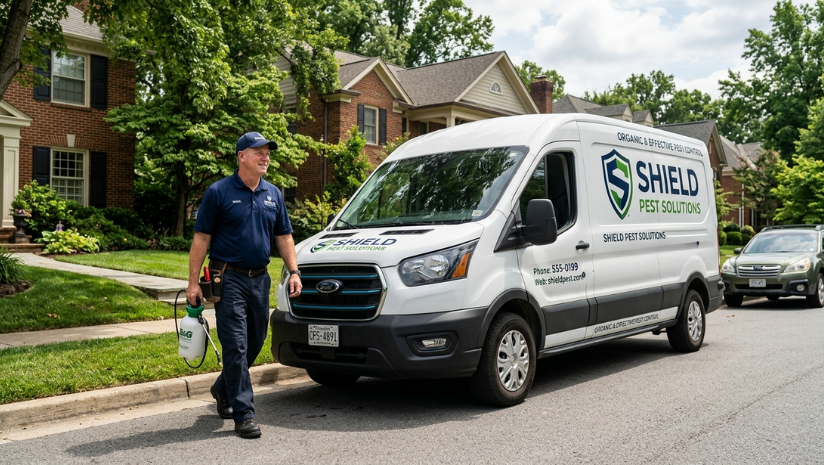
Shield Pest Solutions had been operating in Hillsborough County, Florida for 8 years — a respected name among their existing customer base, but effectively unknown to anyone who hadn’t heard of them through word of mouth. In Tampa’s pest control market, where termites, roaches, mosquitoes, and rodents are year-round problems, they were leaving enormous revenue on the table by relying on a website that Google essentially ignored.
The Challenge
Florida pest control is both a volume and a margin game. Customers need recurring treatments — termite bonds, quarterly sprays, mosquito programmes — meaning each new customer is worth $400–$1,200 per year in lifetime value. Yet Shield was paying $4,800 per month in Google Ads with rising CPCs and declining conversion rates as competitor spend escalated. Their core problems:
- A generic, pest-agnostic website — one “Services” page listed everything from ants to wildlife removal, with zero individual pages that Google could rank for specific pest searches
- Operating in one county, missing three adjacent ones — Pinellas, Pasco, and Polk Counties were within their service radius but completely untargeted in their digital footprint
- No seasonal content strategy — pest control demand peaks seasonally (mosquito season, termite swarm season, rodent winter migration), but their site had no content capitalising on these predictable surges
- National chains dominating local searches — Terminix, Orkin, and Rentokil were outranking them in the local pack despite Shield having better reviews and pricing
💡 The diagnosis: Shield was funding their competitors’ SEO advantage by pouring money into Google Ads on keywords they should have been ranking for organically. Every dollar in ad spend was masking a fixable organic gap.
What We Did
Our strategy had four distinct levers: pest-specific authority, county-by-county expansion, seasonal content timing, and national chain displacement.
Phase 1: Pest-Specific Page Architecture (Month 1–3)
We built dedicated landing pages for every pest type Shield treats: termites, cockroaches, mosquitoes, rodents, bed bugs, ants, fleas, ticks, spiders, and wildlife. Each page included biology of the pest (why they’re drawn to Florida homes), treatment methods, prevention tips, and a clear service CTA. Florida-specific content — humidity-driven termite swarming seasons, palmetto bug behaviour, subtropical rodent patterns — gave each page genuine educational value that generic national chains couldn’t replicate at the local level.
The termite treatment page alone now ranks #2 in Hillsborough County for “termite treatment Tampa” and generates 520 monthly sessions.
Phase 2: Four-County Expansion (Month 2–5)
We built out a full geo-targeted presence in Pinellas, Pasco, and Polk Counties — markets where Shield was already accepting jobs but had zero online visibility. Each county got a hub page, plus city-level pages for the major population centres (St. Petersburg, Clearwater, Largo in Pinellas; New Port Richey, Zephyrhills in Pasco; Lakeland, Winter Haven in Polk). Within 5 months, Shield was generating inbound quote requests from all four counties without spending a penny on paid ads in those areas.
Phase 3: Seasonal Content Calendar (Month 2–12)
Florida pest control has predictable search spikes. We built a 12-month seasonal content calendar timed to publish 6–8 weeks before each surge: termite swarm season content live in February, mosquito prevention guides published in March, back-to-school rodent exclusion content in August. This strategy meant Shield ranked before the seasonal search wave hit — not scrambling to catch up after it.
Phase 4: Google Business Profile Multi-Location Strategy (Month 3–4)
We optimised Shield’s primary GBP and expanded their coverage signals across all four counties through service area expansion, county-specific posts, and a review generation campaign that grew their total review count from 41 to 312 over 12 months — with an average rating of 4.8. They now appear in the 3-pack for pest searches across 9 cities.
Phase 5: National Chain Displacement (Month 6–12)
Beating Terminix and Orkin in local search requires hyperlocal signals they fundamentally cannot replicate at scale. We built content around local testimonials, county-specific pest guides, Florida Department of Agriculture licensing information, and neighbourhood-specific infestation warnings — all content that national chains publish generically but Shield could own authentically.
Results
Twelve months in, Shield Pest Solutions has grown from a single-county operation dependent on Google Ads into a four-county organic powerhouse. They’ve reduced their paid ad spend by 80% while growing total lead volume by 280%.
- 28x Organic traffic (380 → 10,600 monthly sessions)
- +280% Inbound quote requests per month
- 4 counties New markets entered via organic (zero ad spend)
- 312 Google reviews (up from 41 in 12 months)
- -80% Google Ads spend (saved $46,000/year)
- 9 cities Appearing in Google 3-pack for pest searches
Key Takeaways
- Pest-specific pages are the foundation of pest control SEO. You cannot rank for “termite treatment Tampa” with a general “Services” page. Every pest needs its own dedicated URL with authoritative, locally-relevant content.
- Seasonal timing is a compounding advantage. Publishing content 6–8 weeks before seasonal search spikes means you’re already ranking when volume peaks. Competitors publishing reactively are always 60 days behind.
- County-level expansion via SEO costs a fraction of paid ads. Entering Pinellas County via Google Ads would have cost Shield an estimated $2,400/month. Via organic SEO, it added marginal cost to work they were already doing — and produced results that compound year over year.
- National chains have a hyperlocal blind spot. Terminix and Orkin cannot authentically write about Hillsborough County termite swarm patterns or St. Petersburg rodent exclusion specifics. Local businesses that lean into genuine local knowledge will always have a content advantage.
- Reviews are an accelerant, not just a trust signal. Growing from 41 to 312 reviews with a 4.8 average directly moved Shield into the 3-pack in 9 cities — a ranking position with no paid equivalent at any reasonable cost.
I was spending nearly $5,000 a month on Google Ads and watching my cost-per-lead climb every quarter. The SEO Doctors told me I was essentially paying Google to show up where I should have been ranking for free. Within a year we've cut our ad budget by 80%, expanded into three new counties, and we're getting more leads than ever.